
Aging infrastructure
Transformers, breakers, cables, and protection equipment are operating deep into their useful lives.
Distribution Grid Intelligence
Optiminer gives electric utilities a live operating picture of the local distribution grid. That means seeing transformer-level power-line conditions while events are happening, so utilities can locate faults faster, reduce blackout repair time, improve power quality, detect non-technical losses, and make better infrastructure decisions.
Electricity demand is rising from data centers, electric vehicles, electrified heating, automation, and industrial growth. At the same time, much of the grid is old, under-monitored, and expensive to rebuild.
A full physical modernization program is necessary, but it cannot happen quickly. New generation, transmission lines, substations, transformers, and control systems can take years to approve, fund, and build.
Transformers, breakers, cables, and protection equipment are operating deep into their useful lives.
Utilities often do not know exactly what is happening on every feeder, transformer, or neighborhood line.
When local faults are hard to locate, customers wait longer and the economic cost grows.
Renewables, batteries, electric vehicles, and flexible loads change how power flows through the grid.
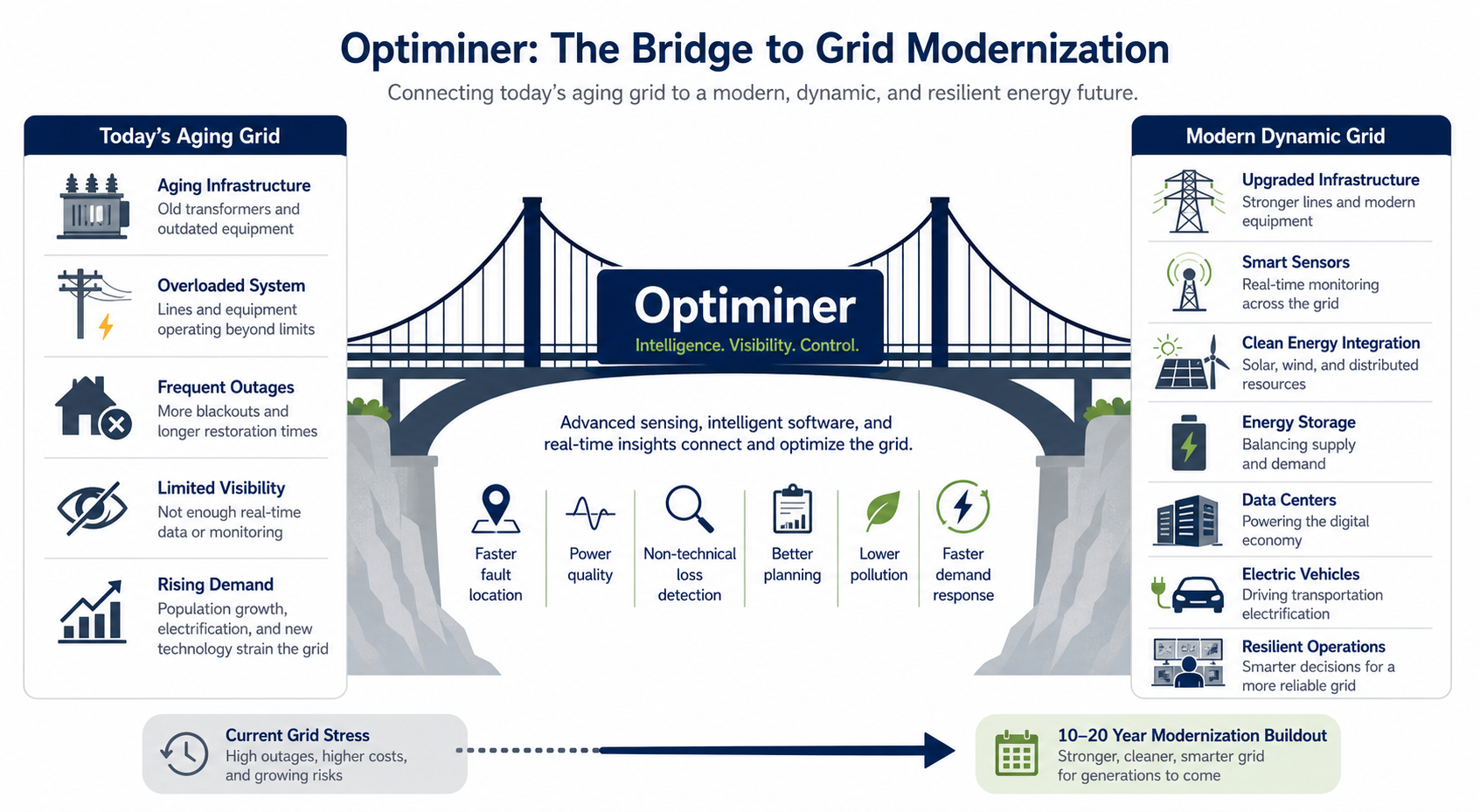
Optiminer is not a substitute for new power plants, new lines, new substations, or new transformers. It is a bridge that helps utilities operate today's grid more intelligently while long-term modernization is planned and built.
A distribution transformer is the equipment that reduces utility voltage to the level used by homes and businesses. The Prospector device is installed at the transformer and communicates with three High Voltage Sensors mounted on the high-voltage phases connected to that transformer.
The High Voltage Sensors measure high-voltage current fault patterns. A fault pattern is the electrical fingerprint created by abnormal events such as lightning, arcing, insulation breakdown, ground faults, or equipment failure.
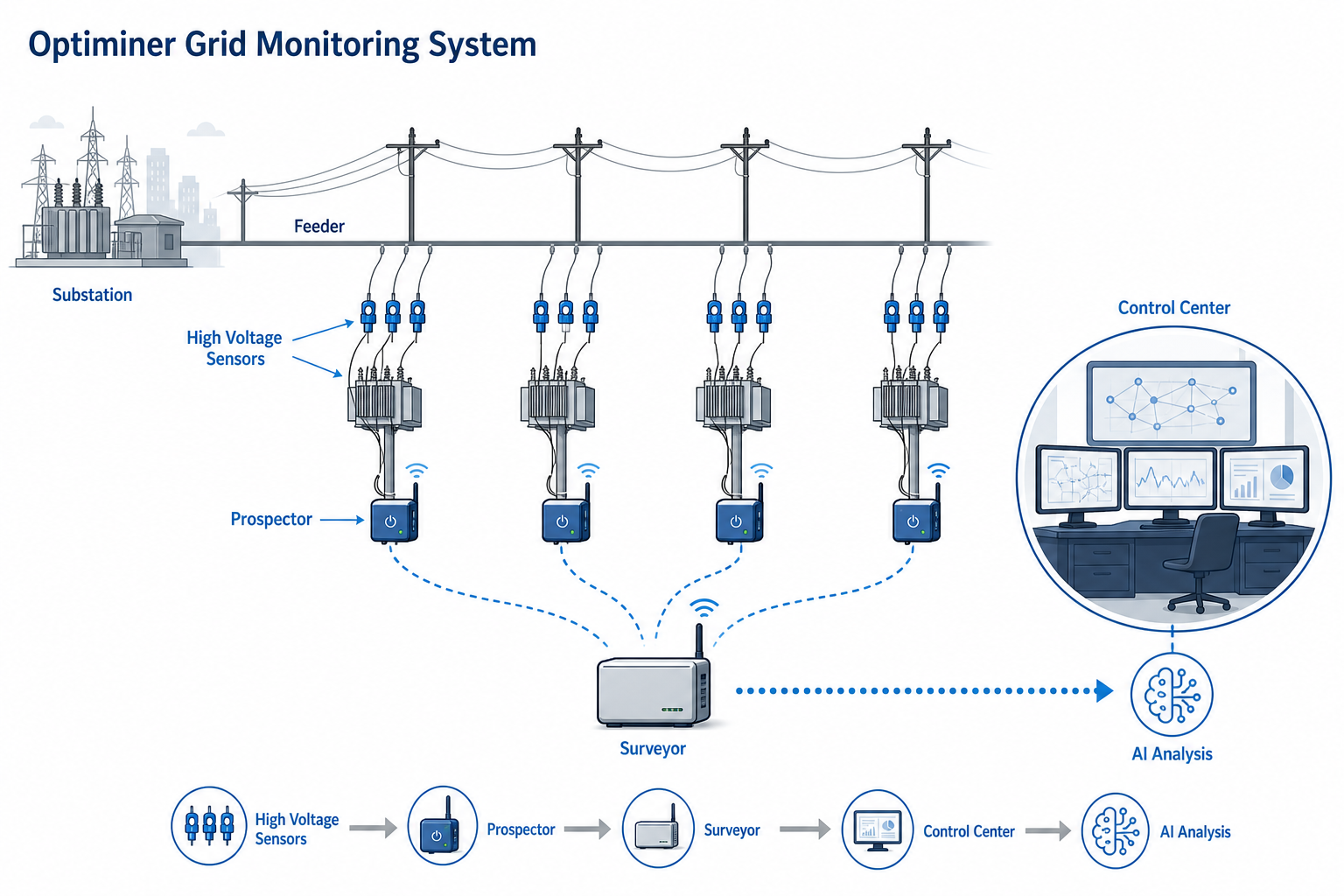
Capture current patterns on each high-voltage phase.
Organizes sensor data and timestamps events with precise location context.
Collects nearby field data and filters duplicate or dependent reports.
Uses artificial intelligence to classify events, locate faults, and support operations.
Storm Response and Control Center Intelligence
During a storm, one primary fault can create many downstream reports. Optiminer helps identify what happened first, what happened because of that first event, and which crews and parts are likely needed.
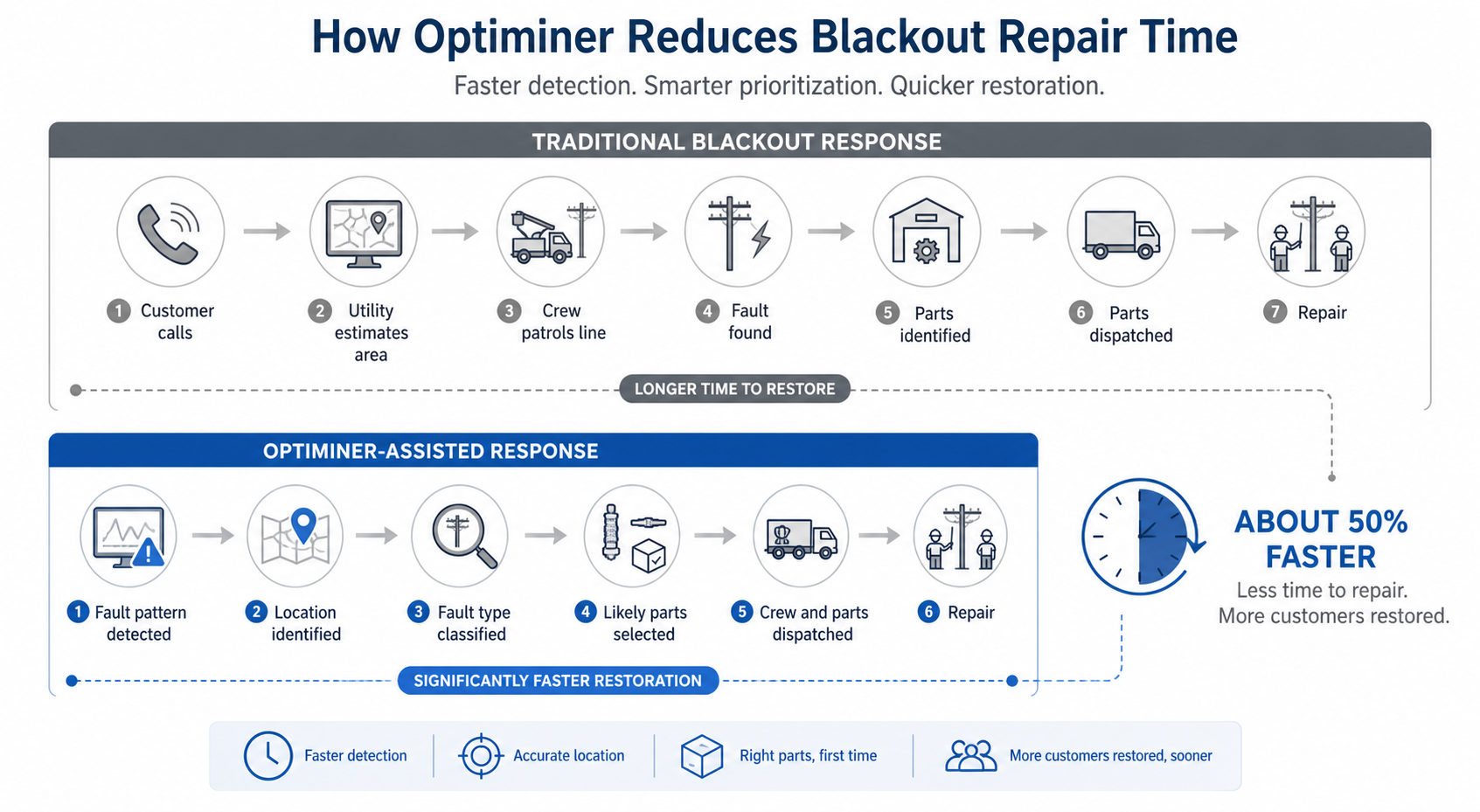
Today, many distribution blackouts are detected reactively when customers call. Crews may then patrol lines to find the problem, identify parts, and coordinate repair.
Optiminer detects the fault pattern directly, helps identify the likely location and type of fault, and supports earlier dispatch of the right crew and parts.
Reduce the duration and impact of blackouts by identifying faults earlier and locating them faster.
Detect interference, voltage problems, arcing, and disturbances that affect sensitive customers.
Support power-flow accounting to identify theft, meter bypass, faulty meters, and unmetered loads.
Show where transformers, feeders, and neighborhoods are under the greatest stress.
Detect abnormal equipment patterns before failures become catastrophic and expensive.
Support faster demand response and reduce reliance on high-emission peaking generation.
High Voltage Sensors are attached to transformer high-voltage cables using an insulated pole and clamping tool. The Prospector is powered from the low-voltage side of the transformer, and a full installation can be completed quickly by utility field crews.
The manufacturing model is designed for scale: contract manufacturers build and ship equipment directly to power utilities, while USPower avoids becoming an inventory-heavy hardware company.
How Optiminer gives utilities transformer-level awareness across feeders, local circuits, and neighborhoods.
How high-voltage fault patterns, precise timing, and artificial intelligence can shorten the path from blackout detection to repair.
How utilities can locate disturbances, interference, arcing, and customer-side equipment problems.
How power-flow accounting can identify theft, meter bypass, faulty meters, and billing errors.
How transformer-level data can guide feeder upgrades, EV charging readiness, new energy resources, and faster controlled load reduction.
How better grid intelligence can reduce peaking generation, spinning reserve, and backup generator use.
Why Optiminer helps utilities extend today's aging infrastructure while the long physical rebuild is planned and built.
Optiminer is a distribution grid intelligence system from USPower. It combines Prospector field devices, High Voltage Sensors, Surveyor communication concentrators, control center servers, and artificial intelligence to help utilities understand what is happening on local power lines.
Optiminer helps close the visibility gap on the distribution grid. This is the local grid inside cities, towns, neighborhoods, and business districts where many blackouts, equipment failures, power quality problems, overloaded transformers, and non-technical losses occur.
High Voltage Sensors capture high-voltage current fault patterns. Optiminer compares those patterns with precise event timing and sensor locations to help identify the likely type and location of a power-line fault.
The Prospector is installed at a distribution transformer. High Voltage Sensors are attached to the high-voltage phases feeding that transformer and measure current fault patterns. Surveyor collects data from nearby Prospectors, filters duplicate reports, and forwards useful information to the control center.
No. Optiminer is a bridge technology. It helps utilities operate today's aging distribution grid more intelligently while long-term generation, transmission, substation, and distribution upgrades are funded, approved, and built.
By identifying the likely fault location and fault type earlier, Optiminer can help utilities dispatch field crews and parts sooner instead of relying only on customer calls and line patrols.
Optiminer can help utilities detect disturbances such as arcing, voltage problems, interference, and failing customer equipment that may affect data centers, laboratories, hospitals, factories, and other sensitive customers.
Optiminer supports power-flow accounting by comparing electricity entering a local area with downstream usage patterns. Unusual imbalances can point to theft, meter bypass, faulty meters, mapping errors, or unmetered loads.
USPower
USPower works with utility stakeholders and business partners who want to improve grid reliability, response time, and distribution-grid intelligence.
Contact USPower